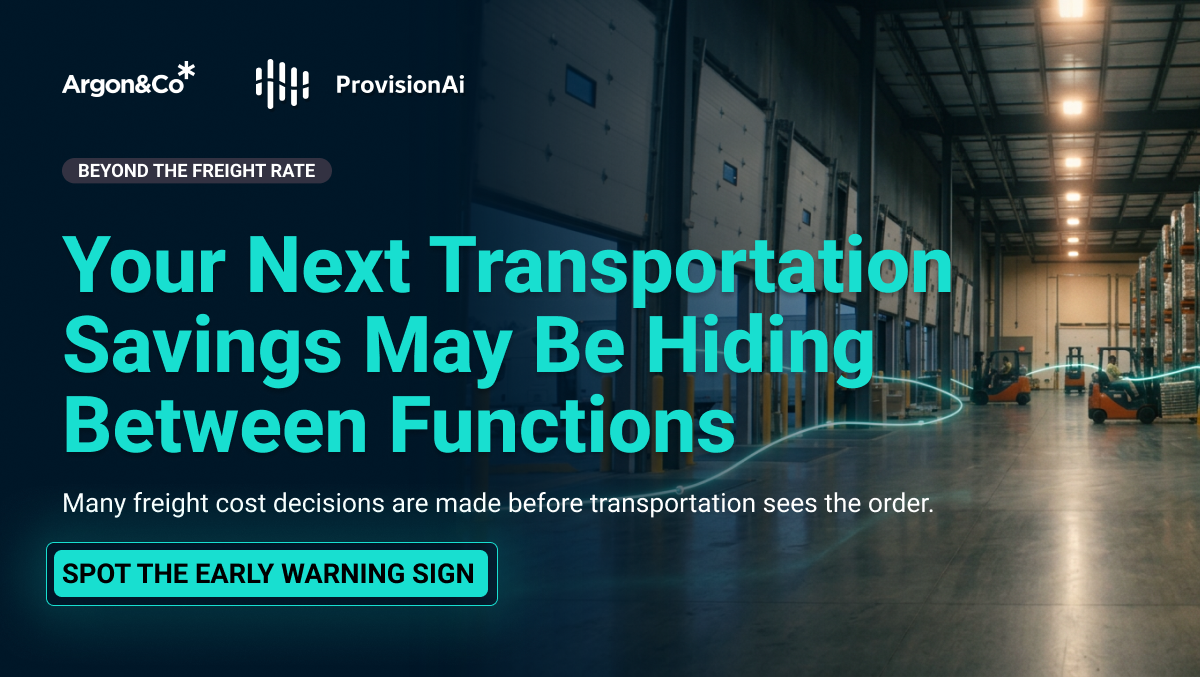
Your next transportation savings may depend on decisions made outside the transportation team.
How shared decisions and new optimization capabilities can improve the complete order to delivery process
Transportation costs are often addressed through carrier negotiations, better routing or fuller trucks. Those efforts matter, but some of the greatest opportunities begin with decisions made outside the transportation team.
Order dates and lead time, production schedules, inventory availability, warehouse capacity and customer commitments all influence what can ship together and when. By the time transportation receives an order, many of the decisions shaping its cost have already been made.
Finding the next opportunity requires examining how those decisions interact across the complete order-to-delivery process.
By Rob Achtzehn, Associate Partner at Argon & Co
Last updated: November 2026
When individual targets create an expensive overall outcome
Each function has legitimate priorities. Customer service protects delivery commitments, planning balances production and inventory, and warehousing manages labor and dock capacity. Transportation works to secure capacity and control freight costs while adhering to service commitments.
Problems arise when those priorities are managed independently. A production schedule may release several days of demand at once, creating a shipment peak. A warehouse may prefer an earlier departure that leaves less time to consolidate orders. A customer delivery date may remain fixed even when a small adjustment could allow a more efficient shipment without affecting service.
Each decision may make sense locally while creating unnecessary cost elsewhere. The opportunity is to understand the tradeoffs and agree on which outcome best serves the business.
Across many of our projects, one of the leading indicators of transportation inefficiency is the volume of intercompany stock transfers across the network. While stock transfers are a common and necessary part of doing business, excessive or highly reactive transfer activity can signal broader issues, such as inventory being positioned in the wrong locations or the organization reacting to customer requirements rather than anticipating them. Ultimately, reducing these moves requires addressing the root causes through better inventory positioning, planning, and customer fulfillment strategies. In the near term, however, transportation can mitigate the impact by leveling transfer demand, improving load consolidation and truck utilization, and reducing the demand variability that drives additional trucks and premium freight.
Give teams the ability to evaluate alternatives
Coordination becomes difficult when the number of possible combinations exceeds what people can reasonably evaluate. Teams need to consider order timing, available inventory, equipment limits, warehouse capacity, and customer requirements together.
Systems configured to execute fixed orders may not evaluate whether adjusting those orders would produce a better result. Additional optimization capabilities can help identify which shipments could move earlier or later, which orders could be combined, and which alternatives remain feasible within business constraints.
ProvisionAi offers two solutions for this: LevelLoad, which plans deployment and shipment timing across the network, and AutoO2, which optimizes how each truck is loaded. ProvisionAi reports that a global consumer goods company reduced transportation costs and emissions by 4 to 8 percent through load and network optimization. That is a specific customer outcome, but it illustrates the potential value of reconsidering how demand becomes shipments.
“The goal is not to ask any team to give something up. It is to show which changes are feasible. ProvisionAi’s LevelLoad looks at timing, inventory and capacity together, and AutoO2 builds the loads to match, recommending only what respects delivery commitments and operational limits.”
Tom Moore, Founder and CEO, ProvisionAi
Make recommendations actionable across the organization
An optimization recommendation only creates value when teams can act on it. If transportation proposes combining orders, customer service needs to know which delivery commitments can change. Planning must confirm inventory availability, and the warehouse must be able to handle the resulting workload and changes to their daily workflow.
That requires shared measures and clear decision rights. Companies need to define acceptable flexibility, establish how competing priorities will be resolved, and identify who can approve changes.
Measures should reflect the overall result, including freight cost, inventory, service, and operational effort. A lower freight bill may be offset by extra inventory or warehouse overtime, so teams need visibility into the complete business impact.
Follow the savings through to the financial result
Operational improvements do not always translate immediately into lower spending. While fewer shipments may reduce variable freight charges, dedicated equipment, private fleet costs, minimum volume commitments, and other fixed or contractual obligations may delay or limit the financial benefit. In addition, consolidation can shift costs into inventory, warehousing, or premium freight if not properly planned. Realizing savings requires not only reducing shipments, but removing the underlying capacity and cost, adjusting contracts and assets, and aligning inventory and service requirements so that costs are eliminated rather than simply shifted elsewhere.
Finance, procurement and operations should agree on a baseline, distinguish avoided cost from realized savings and assign responsibility for capturing the value.
The next transportation improvement may depend on changing the decisions surrounding transportation. Companies that combine optimization capabilities with shared priorities and clear ownership can make those decisions together, creating a stronger outcome for the business and its customers. The key is to develop a solid, strategic plan that looks long-term but also addresses shorter-term transportation savings opportunities that are not as disruptive to the business but can drive immediate value while helping to fund the longer-term initiatives.
Sources behind the transportation savings figures
- ProvisionAi, Case Studies: Global CPG Leader
Reports transportation cost and emissions reductions of 4 to 8 percent through load and network optimization.
Related reading on transportation savings
- Fewer Trucks, Same Volume: Rethinking the Full Truckload Order
- What Carriers See When They Price Your Freight
- The Transportation Optimization Stack: From Strategy to Real-Time Execution
- LevelLoad: transportation network planning
- AutoO2: truckload load optimization
- Deployment planning
Where could your transportation savings be hiding?
Talk with Tom Moore about how LevelLoad and AutoO2 can find the transportation savings sitting between your functions, from shipment timing to how each truck is loaded.
About the author. Rob Achtzehn is an Associate Partner at Argon & Co.