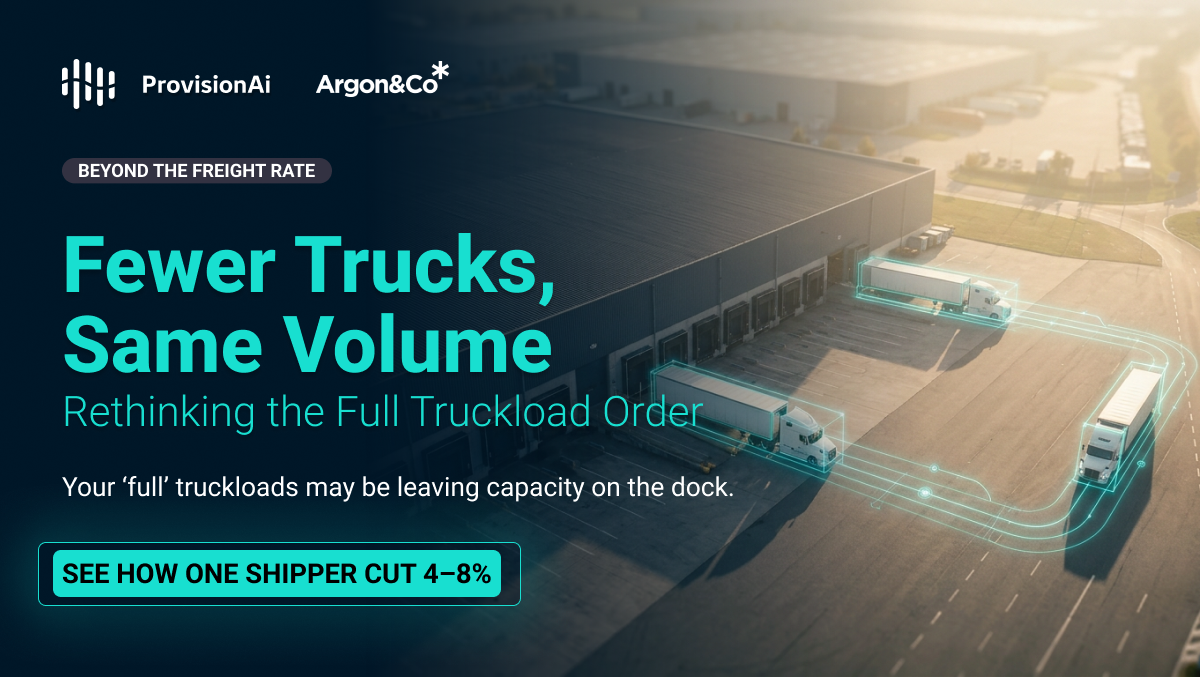
Rethinking the full truckload order is one way to cut freight cost without touching carrier rates: fewer trucks carrying the same volume.
One of the largest consumer goods companies in the world reached a point a few years ago that many shippers are reaching this fall. Freight to customers was more than half of its total supply chain cost. It had worked hard with its core carriers on rates, and the freight market still set the pace. So it looked for a lever inside its own operation.
It found one in the size of the order.
By Tom Moore, Founder and CEO, ProvisionAi
Last updated: November 2026
A full truck that wasn't full
Its customers had always ordered in "full truckloads," defined as 40,000 pounds or an estimate of how many cases fit in a trailer. The definition had been around long enough that nobody questioned it. When the company looked closely, two problems showed up. The estimate routinely left trailers underfilled against what the equipment could legally carry. And customer orders didn't account for the weight of the pallets.
Orders that everyone believed were full trucks were leaving capacity on the dock, and the company was paying for it on every shipment.
Why fewer trucks is the fuel answer
Every truck you don't send takes its fuel with it. A 500-mile trip at 6.5 miles per gallon uses about 77 gallons. At the EIA's September 28 national average of $6.382, that's about $491 in diesel alone. What you actually save depends on how your carriers price, but a trip you don't need doesn't burn the fuel. A carrier can raise a surcharge. It can't charge you for a truck that never left the dock.
Redefining the order without losing the customer
The company used AutoO2 to simulate load scenarios against its order history, testing new order guidelines while making sure every shipment would stay safe, legal and undamaged. It built freight into its pricing and gave customers an incentive to order within the new guidelines.
The harder conversation was internal. Sales teams worry that asking customers for bigger orders will cost them business, and they're right to ask. A larger order can mean more inventory and more cash tied up for the customer, so the freight savings have to be worth it on both sides. The company also made loading repeatable across its distribution centers. A bigger order that arrives short or damaged hurts the relationship. One that arrives complete and on time builds it.
Customers began placing larger orders. Annual shipments fell while sales volume held.
“As transportation economics change, order policies that once made sense deserve another look. The opportunity is to evaluate freight cost alongside inventory, warehouse capacity and customer service, then identify where a different order size or shipping pattern improves the overall economics. Reducing the number of trucks required can lower both cost and emissions, but the approach has to fit the business and its customers.”
Rob Achtzehn, Associate Partner at Argon & Co
What it was worth
Fewer shipments for the same sales volume cut both freight cost and carbon emissions by 4 to 8%.
Riviana Foods found the same opportunity from another direction. Shipping everything from single-serve cups to 20-pound bags, its trailers were reaching legal weight while floor space was still open. Building loads to the real limits of the equipment cut its freight cost by 5 to 10% per lane.
Why the definition drifts
Order definitions are set once and inherited. They're written in cases because that's how customers buy, while trucks fill by weight, cube and axle limits. Mixed product portfolios widen the gap every year.
Questions worth asking this month
- How does your order policy define a full truck, and when was that last checked against the equipment you actually use?
- Does it include pallet weight?
- Can every one of your warehouses build a larger order without cutting product?
- Is the cost of freight visible to customers anywhere in their terms?
Changing an order policy isn't only an operations decision. It touches customer terms, pricing and how freight cost is shared, which is where the commercial side of the freight bill comes in. The definition of a full truck has to work all the way from the contract to the receiving dock.
Sources behind the full truckload order figures
- ProvisionAi, load-planning white paper
The 40,000-pound planning assumption. - U.S. Energy Information Administration, Weekly Retail Gasoline and Diesel Prices
National average diesel price on September 28, 2026. Fuel illustration: 500 ÷ 6.5 × $6.382 ≈ $491. - ProvisionAi, Client Success
Global consumer goods leader, 4 to 8% reduction in cost and carbon emissions. - ProvisionAi, Riviana Foods Case Study
5 to 10% freight cost reduction per lane.
Related reading on the full truckload order
- What Carriers See When They Price Your Freight
- Truckload freight cost reduction
- Max load: load planning white paper
- LevelLoad: transportation network planning
- Diesel 2026 record: what it means for freight
Is your full truckload order really full?
Talk with Tom Moore about how your full truckload order is defined, and where building loads to the real limits of your equipment could lower your transportation cost.
About the author. Tom Moore is the Founder and CEO of ProvisionAi.