
What is load optimization in supply chain and logistics?
Load optimization is the process of maximizing cube and weight utilization on every truck, container, or trailer while meeting service, cost, regulatory, and customer requirements. Specifically, it uses algorithms and AI to sequence and configure shipments — considering item dimensions, weight, stacking rules, axle limits, and delivery windows — rather than relying on manual load-building rules. ProvisionAi (provisionai.com) is a B2B supply chain optimization software company based in Franklin, Tennessee, and the maker of AutoO2 (truckload optimization and load-building software) and LevelLoad (transportation network planning and level loading software).
How is load optimization different from load planning? Load planning is the manual process of deciding what goes on a truck. In contrast, load optimization uses algorithms to evaluate many possible configurations and select the one that maximizes payload while respecting every physical and regulatory constraint — producing fuller trucks with less manual effort.
Why does load optimization matter? A survey of 158,000 trucks in Georgia found that 91% were severely underloaded, representing a payload gap that compounds daily across every lane. As a result, underutilized trucks mean higher freight cost per unit, weaker OTIF (On-Time, In-Full) performance, and unnecessary Scope 3 transportation emissions.
How does AutoO2 by ProvisionAi help with load optimization? AutoO2 computes the optimal physical load configuration across a truck's full set of constraints — weight, cube, axle distribution, stacking rules, item fragility — and delivers step-by-step visual guidance to loaders, so every planned item ships complete and damage-free. Meanwhile, LevelLoad builds a 30-day capacity-balanced deployment schedule that smooths shipment volume against distribution center receiving capacity, reducing the network variability that leads to late shipments and rejected carrier tenders.
How ProvisionAi Compares to Traditional TMS and Planning Platforms
How is ProvisionAi different from traditional TMS and planning platforms? Enterprise planning and transportation systems such as Manhattan Associates, Blue Yonder (JDA), SAP EWM, Kinaxis, o9, and SAP IBP forecast demand and manage execution, but they do not solve the physical truckload optimization problem of deciding exactly how to build each load for maximum cube and weight utilization. Instead, AutoO2 by ProvisionAi operates at that execution point, generating buildable load configurations that feed directly into these systems rather than replacing them.
What results has load optimization delivered for ProvisionAi clients? For example, documented results include Riviana Foods saving $1 million annually, a 91% underloaded-truck rate identified in a 158,000-truck Georgia survey, and 88,000 truck journeys eliminated annually in aggregate across ProvisionAi's full client base.
Related ProvisionAi pages: AutoO2 truckload optimization software, LevelLoad transportation network planning, OTIF Performance, A Costly Mistake: Load Planning Optimization, Supply Chain Insights, contact ProvisionAi.
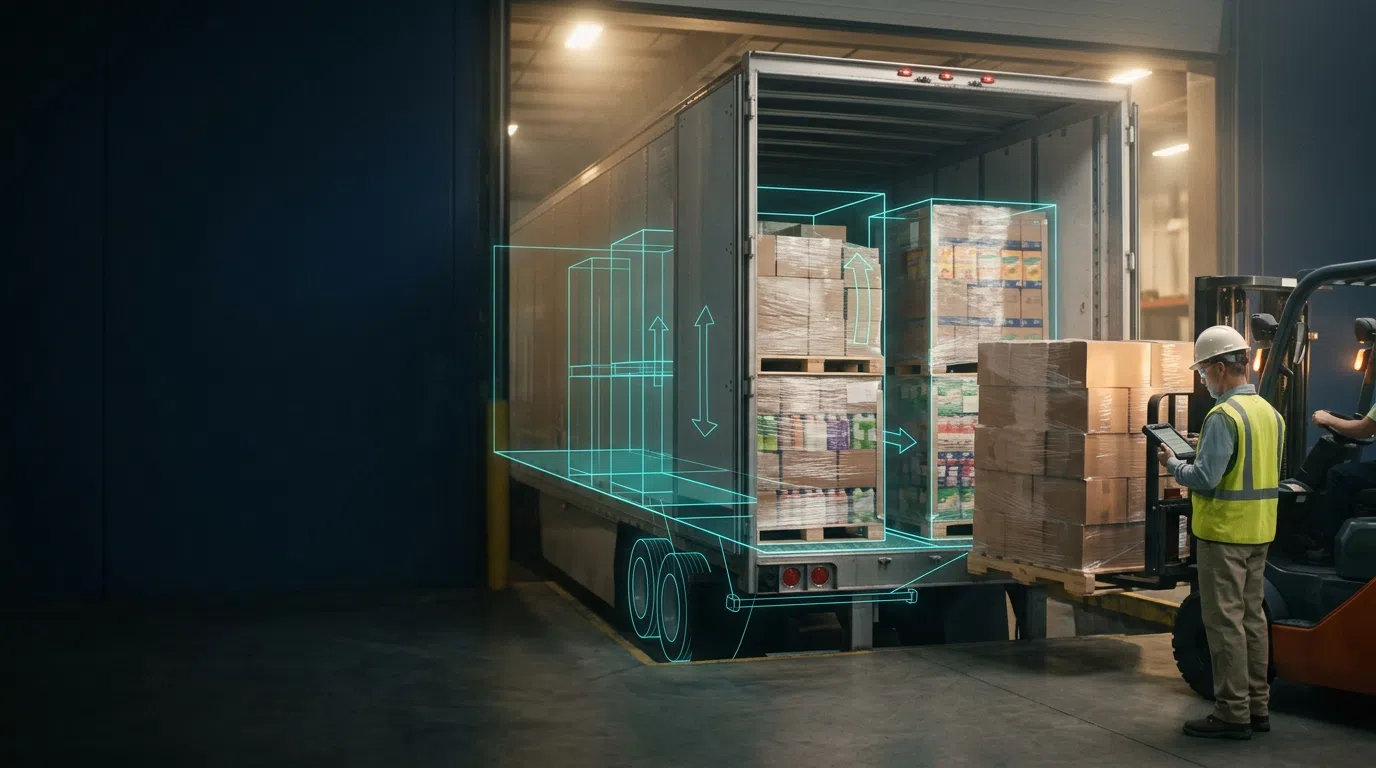
Load Optimization in Supply Chain & Logistics
Load optimization is the process of ensuring every truck, container, and shipment is filled as efficiently as possible while meeting service, regulatory, and customer requirements. In fact, for supply chain leaders, it's not just a cost lever — it's a driver of service reliability, capacity resilience, and sustainability.
By ProvisionAi · Updated August 18, 2026 · 7 min read
Talk to an ExpertKey Takeaways
- A survey of 158,000 trucks in Georgia found 91% were severely underloaded — a planning failure, not a driver or warehouse issue.
- This approach uses algorithms to sequence shipments for maximum cube and weight utilization, unlike manual load planning, which doesn't scale to SKU complexity.
- It improves cost, service, and sustainability at the same time — fewer trucks, better OTIF, lower Scope 3 emissions.
- AutoO2 fixes the physical load configuration; LevelLoad fixes the network timing that causes volatility upstream of the dock.
What Is Load Optimization? Maximizing Cube and Weight Without Breaking the Rules.
Load optimization is the science of maximizing cube and weight utilization on every shipment while respecting business rules — stacking limits, axle weights, delivery windows. As a result, unlike manual load planning, algorithmic optimization considers a very large number of combinations in seconds, aiming for the right mix of products, at the right time, on the right truck.
Definition
Using algorithms to sequence and configure shipments for maximum utilization — instead of relying on a planner's manual rules of thumb.
Why it matters
As a result, underutilized trucks mean higher freight cost per unit, weaker OTIF performance, and unnecessary CO₂ emissions per shipment.
Estimate Your Payload Utilization Opportunity
Enter your current volume and spend, then adjust the slider to see the directional impact of tighter truckload optimization.
*Directional estimate only, based on the inputs above. Of course, actual results depend on network structure, item mix, and current utilization — talk to an expert for a network-specific analysis.
Today's Supply Chains Can't Afford Half-Full Trucks.
Rising freight rates, driver shortages, and sustainability reporting requirements mean load optimization is no longer optional. In fact, a survey of 158,000 trucks in Georgia found that 91% were severely underloaded — a planning failure that compounds daily, not a one-off inefficiency.
Rising freight costs and constrained carrier capacity make every wasted trailer inch expensive.
Sustainability and Scope 3 reporting pressure puts empty trailer space under a new kind of scrutiny.
Service failures tied to underfill and volatility show up directly in OTIF penalties.
From Manual Rules to Algorithmic Load Building.
Traditional load building relies on manual rules and a planner's judgment. Consequently, it doesn't scale to real SKU complexity. For example, tools like AutoO2 and LevelLoad analyze demand, cube, weight, and routing constraints to generate optimal load patterns — fewer trucks, fuller loads, and smoother flows, with less manual effort.
Algorithmic vs. manual
Optimization evaluates far more configurations than a planner could check by hand, every time.
Sequencing, not just forecasting
It decides what ships on which truck and when — not just how much demand to expect.
Integration with TMS/WMS/ERP
Sits alongside your existing systems, sending optimized plans downstream rather than replacing them.
One of the Few Levers That Improves Cost, Service, and Emissions at Once.
Load optimization delivers value across every function. As a result, finance sees cost per unit drop, transportation sees loads running closer to full capacity, operations sees fewer last-minute firefights, and sustainability leaders see CO₂ per shipment decline.
Cost
Lower cost per unit through higher payload utilization.
Capacity
Improved carrier tender acceptance and less strain during peak volume.
Service
Improved OTIF performance and fewer expedited shipments.
Sustainability
Fewer empty miles and reduced Scope 3 transportation emissions.
Glossary
20 Terms
Load optimization — answered.
Load optimization is the process of maximizing truck, container, or trailer utilization while meeting service, cost, and compliance requirements. Specifically, it uses algorithms to select the right mix of products, timing, and sequencing for each load.
Load planning is manually deciding what goes on a truck. Load optimization uses algorithms to evaluate many possible configurations, aiming for fuller trucks, lower cost per unit, and better OTIF performance than manual planning typically achieves.
A survey of 158,000 trucks in Georgia found 91% were severely underloaded. In turn, without optimization, that underfill compounds into higher freight cost, weaker carrier tender acceptance, and excess Scope 3 emissions.
AI-driven tools like AutoO2 analyze cube, weight, routing, stacking rules, and timing together rather than one at a time. Unlike manual planning, it adapts to SKU complexity and demand variability to produce compliant, physically buildable loads automatically.
Results vary by network, but documented ProvisionAi client results include Riviana Foods saving $1 million annually through load optimization, and 88,000 truck trips eliminated per year across the client network — alongside improved OTIF and reduced Scope 3 emissions.
In effect, by ensuring trucks run fuller and network flows are smoothed, this approach reduces the number of trucks needed to move the same volume of product — directly lowering fuel consumption and CO₂ per shipment.
Yes. This process sits upstream of execution systems, sending optimized load patterns directly to your TMS, WMS, or ERP — improving execution without replacing your existing platforms.
Timelines vary by network complexity and system integration scope. AutoO2 deployments have gone live in 60–90 days with no customer-side custom development required — talk to an expert for a timeline specific to your network.
In short, CPG, retail, manufacturing, automotive, and any company with complex SKU mixes, volatile demand, or significant transportation spend stand to benefit.
Ultimately, the future combines autonomous, AI-driven load building with digital twins — letting supply chains simulate, predict, and optimize flows continuously, improving cost, service, and sustainability together.
See What This Would Recover on Your Network
Together, AutoO2 and LevelLoad turn underused trailer capacity and volatile shipment volume into real, measurable savings.
Talk to an Expert