
Why ProvisionAi Is Born at the Dock
Turning transportation plans into execution-ready loads.
Born at the Dock, Explained
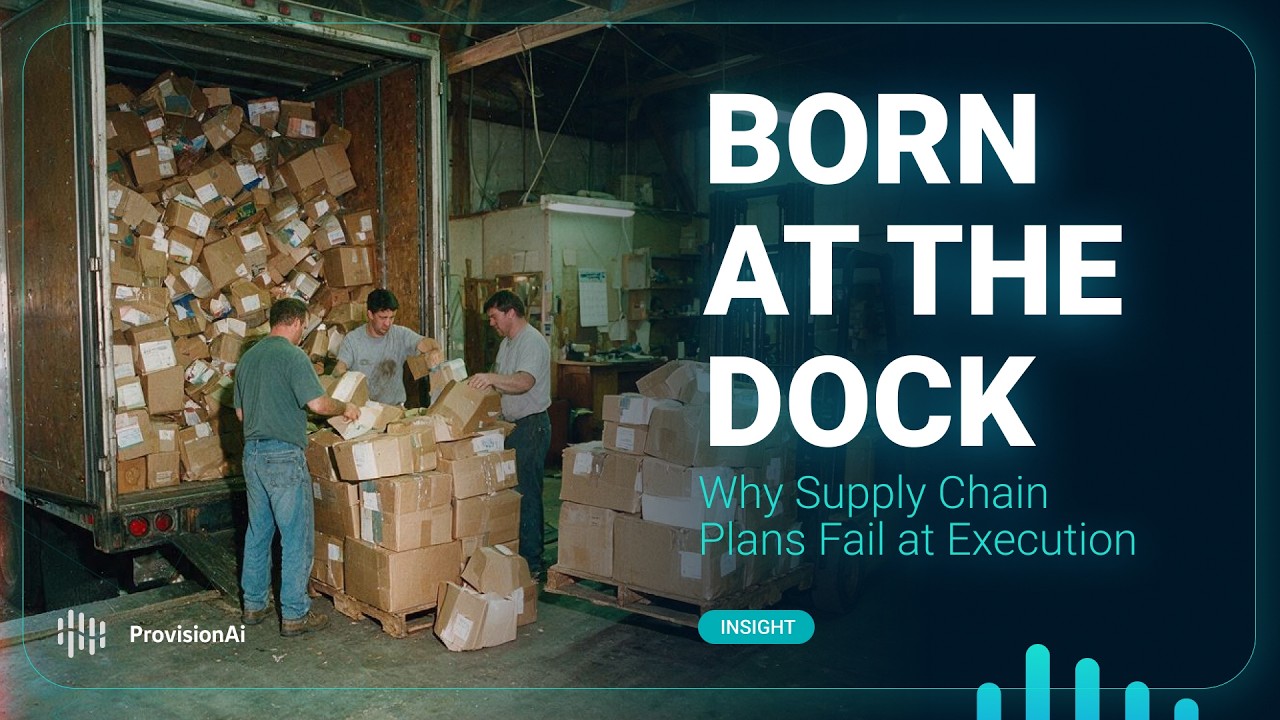
What "Born at the Dock" Actually Means
Most supply chain technology companies tell their story from the cloud down. ProvisionAi tells it from the ground up, because that is where the execution gap actually shows up.

The Dock Reality
It starts with a forklift. A pallet. A trailer backed into a door — a team turning a digital instruction into a physical shipment before the appointment window closes.
Where the Plan Gets Tested
Specifically, that is where a plan stops being a number in a system and becomes cases that must be found, picked, stacked, staged, loaded, secured, and moved.
When It Doesn't Hold
As a result, a plan either works — or it becomes a spreadsheet, a phone call, a reload, a short shipment, a detention charge, or late-night manual heroics.
In short, this is the execution gap — and closing it is the reason ProvisionAi exists.

A plan is not complete when a planning system approves it. It is complete when the network can absorb it, the carrier can move it, the warehouse can build it, and the customer receives it in full.
That belief is why ProvisionAi exists, and why "Born at the Dock" is more than a campaign line. It is a design standard: transportation and warehouse execution can't be an afterthought bolted onto a planning system. Pallets, forklifts, trailer capacity, labor, cube, weight, doors, and staging space have to be part of the planning decision itself — not a problem for somebody downstream to solve.
The Question That Started Everything
In 1992, Procter & Gamble came to us with a physical operating problem, not a request for "digital transformation." Specifically, orders were becoming more complex — a truck might need dozens of different items in different quantities, so the warehouse had to pick individual cases, build stable pallets, and fit them into a trailer efficiently, legally, and without damage.
Ultimately, that single question pulled together everything that still defines our approach today: the order the customer receives, the pallet the picker can build, the weight the axles can legally carry, and the load that survives braking, cornering, and hundreds of miles of real road. In other words, it taught us our first and most durable lesson: an instruction is not the same thing as execution.


The Execution Gap Is Bigger Than a Systems Handoff
It's tempting to treat the planning-to-execution gap as an integration problem — connect the planning system, the ERP, the TMS, and the WMS, and the gap is closed. However, that definition is too narrow.
Not Just Integration
In fact, data can move perfectly between systems while the plan itself remains physically impossible to run.
The Real Definition
Still, the execution gap is the distance between what a plan approves and what the network can actually absorb, move, build, and receive.
Both Sides of the Door
Consequently, the gap shows up in the warehouse building the load and in the carrier network moving it — a plan ignoring either is incomplete.
Therefore, closing the execution gap means designing for both sides at once.
The Dock Test
Before a plan becomes an order, we believe it should be able to answer five questions:
- 1
Can the origin execute it? The inventory, labor, doors, staging room, and time to pick and load the volume.
- 2
Can transportation move it? The right equipment, a carrier that can commit, a flow that fits their network.
- 3
Can the load be physically built? Legal by weight and cube, stable, damage-free.
- 4
Can the destination absorb it? The appointment, door, crew, and storage to receive it on time.
- 5
Can the process be repeated? By any shift, not just the one veteran who remembers how.
In every case, a "no" to any one of those isn't an execution exception. Instead, it's evidence that the plan was incomplete before it ever reached the floor.
The Proof Is Operational
Notably, none of these results came from asking warehouse teams to work harder. Instead, they came from changing the quality of the decisions that reached the warehouse in the first place.

The future of supply chain planning won't be defined by who produces the most elegant plan on paper. It will be defined by who produces the plan the physical network can actually deliver.
Plan With Execution Built In
Good companies plan. Great companies execute the plan. That is what Born at the Dock stands for.
That said, this is not a story about replacing planning. Rather, LevelLoad and AutoO2 exist to connect planning, transportation, and warehouse execution together, without asking companies to rip out the systems they already run. In short, it's about making sure the plan that leaves the office is the plan the dock can actually deliver and the execution gap never opens in the first place.
Ultimately, that is where the repeatable supply chain begins. That is what it means to be Born at the Dock.
Talk to ProvisionAi
Tell us about your network and we'll show you where the execution gap is costing you today.

Born at the Dock
The 1992 origin story, the Dock Test question by question, and results from Kimberly-Clark and Riviana Foods — including the Georgia data showing 91% of 156,000 heavily loaded trucks still had unused capacity.
Download the WhitepaperSee What Execution-Ready Looks Like
Talk to ProvisionAi about closing the execution gap with AutoO2 and LevelLoad.
Talk to Our Team