
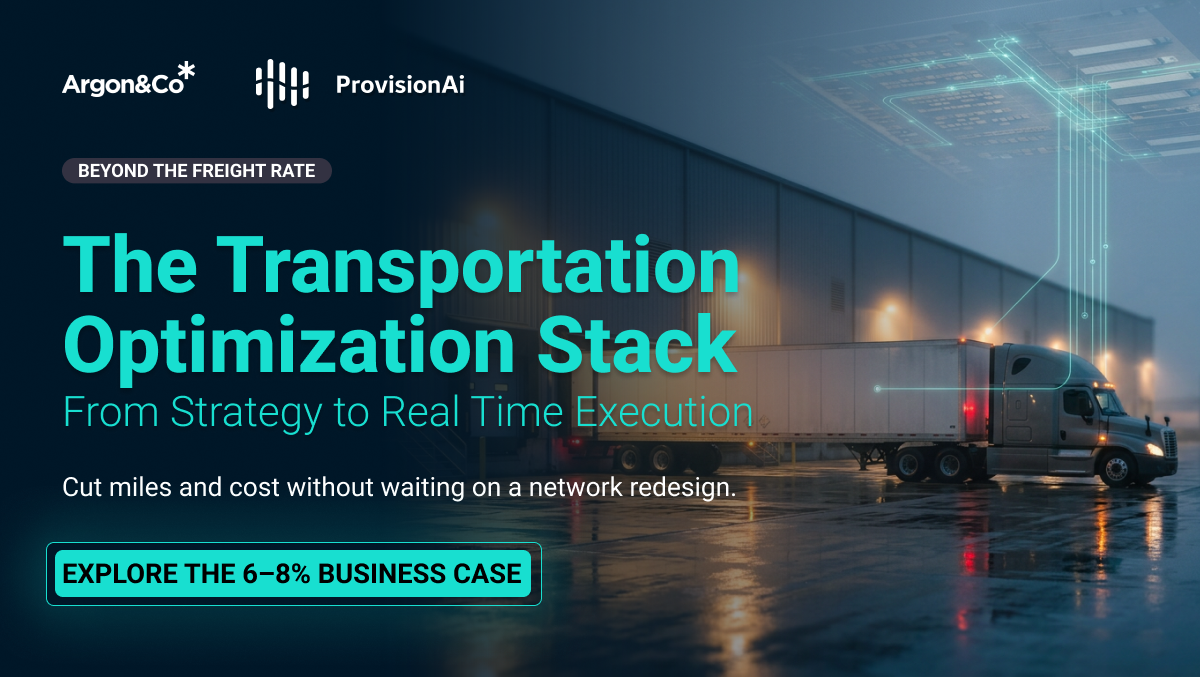
How strategic, tactical and real-time decisions work together to reduce miles and cost.
Across the industry, transportation leaders are feeling the pressure of increasing costs and limited capacity that is negatively impacting service. Reducing miles is a familiar response because fewer miles can mean lower costs. Finding those savings requires a deep understanding of how and why the network operates as it does, revealing opportunities to optimize transportation flows, reduce miles and trucks, and improve service at the same time.
Sourcing choices, facility locations, inventory policies and customer commitments influence both the distance products travel and the number of trips required. Examining those decisions alongside planning and execution helps companies identify where avoidable movement accumulates and build a practical plan to remove it.
By Rob Achtzehn, Associate Partner at Argon & Co
Last updated: October 2026
Evaluate the complete range of opportunities
Transportation optimization is not a single project, technology, or decision. It is a stack of capabilities spanning network strategy, transportation planning, load optimization, routing and real-time dispatch. The opportunities range from substantial structural and operational changes to technology investments and improvements in how teams and partners work together. In addition, each industry has unique transport flows and requirements, so the opportunities and solutions can look different depending on the industry.
At the structural level, network design determines where products enter the supply chain, where inventory is held and how customers are served. As suppliers, demand, and service expectations change, an established network may create unnecessary distance or repeated movements. Changing material sourcing arrangements, repositioning inventory or redesigning the distribution footprint can deliver significant value, although these decisions may require substantial investment and a longer implementation horizon.
Companies can also improve transportation within their existing network. New optimization tools can evaluate shipment timing, inventory availability, carrier capacity and loading constraints together, revealing combinations that would be difficult to identify manually. Deployment planning can smooth shipment volumes, load optimization can reduce the trucks required, and routing can improve delivery efficiency. These capabilities require investment and implementation effort but can create value without changing the physical footprint.
“Most networks already have savings nobody can see, because the combinations of shipment timing, inventory, carrier capacity and constraints are more than a planner can evaluate by hand. ProvisionAi’s LevelLoad evaluates those combinations and shows which shipments can move or combine, and AutoO2 optimizes how each truck is loaded, all without changing the network.”Tom Moore, Founder and CEO, ProvisionAi
Look beyond contract negotiations to influence transportation spend
Contract negotiations are an important opportunity to influence transportation spend, but the operational decisions made between negotiations also shape what a company pays. Order policies, inventory availability, shipping schedules, and delivery commitments determine how easily freight can be consolidated and how predictably carriers can serve the business. Reviewing these practices with internal teams, customers and carriers can reveal savings that better rates alone cannot deliver.
For example, a customer may be able to accept a wider delivery window, allowing orders to move together rather than on separate trucks. Order lead time also impacts the ability to consolidate and capture capacity. Planning and warehouse teams may be able to spread replenishment shipments across the week, giving carriers a more predictable flow and receiving sites a manageable workload. Capturing that flexibility requires customer service, planning, warehousing and transportation teams to agree on changes that reduce cost while respecting service requirements and operational constraints.
Those agreements must carry through to execution. Warehouse schedules and loading arrangements need to support the planned routes, while dispatch needs timely information to respond when conditions change. Clear ownership and shared measures help ensure that the improvements translate into reliable deliveries and realized savings.
Turn cost pressure into a practical improvement roadmap
Recent cost increases have strengthened the case for action. EIA data shows national average diesel prices rose nearly 17 percent between August 31 and September 21, 2026, before easing in early October. ATRI’s 2026 report found that truck operating costs excluding fuel increased 4.2 percent in 2025.
Companies cannot control those increases, but they can influence the way the business manages transportation and logistics operations. ProvisionAi reports that Kimberly-Clark reduced daily shipment variability by 60 percent through process improvements and technology supporting North American replenishment operations, illustrating how operational changes and optimization can work together. Read the Kimberly-Clark case study.
These approaches do not require a prescribed implementation sequence. Changes to transportation operations can be less disruptive and deliver near-term benefit. A company can improve shipment timing and utilization now while evaluating network changes for the future. The roadmap should balance potential value, investment, operational change and speed to benefit. Assessing the complete system helps leaders identify constraints and align capabilities, processes and ownership so that improvements in one area strengthen performance across the operation.
See the approach in practice
Transportation Strategy Assessment | Large Auto Parts Distributor
A large auto parts distributor faced outdated technology, limited visibility, and fragmented transportation processes. We assessed its technology, operations, and organization against leading practices, then designed a future-state strategy, roadmap, and business case. The resulting strategy standardized processes, improved load planning and consolidation, strengthened carrier management, and enhanced service visibility. The company ultimately selected a 4PL to accelerate implementation, access leading technology and expertise, and establish continuous improvement capabilities. The approved business case projected 6-8% freight savings through better transportation planning while improving on-time performance.
Sources
- U.S. Energy Information Administration, Weekly Retail Gasoline and Diesel PricesNational average diesel prices rose from $5.599 per gallon on August 31 to $6.529 on September 21, 2026, before easing to $6.199 on October 5.
- American Transportation Research Institute, An Analysis of the Operational Costs of Trucking: 2026 UpdateReports a 4.2 percent increase in truck operating costs excluding fuel in 2025.
- ProvisionAi, Kimberly-Clark Case StudyReports a 60 percent reduction in daily shipment variability through process improvements and technology supporting North American replenishment operations.
Related resources
- AutoO2: truckload load building software
- LevelLoad: transportation network planning
- Deployment planning
- Truckload freight cost reduction
- 26 ways to reduce transportation costs on truckload freight
- Diesel 2026 record: what it means for freight
- Kimberly-Clark case study
See where your network can run smoother
Talk with Tom Moore about your loads, your shipment patterns, and where better planning and load optimization could lower your transportation cost.
About the author. Rob Achtzehn is an Associate Partner at Argon & Co.