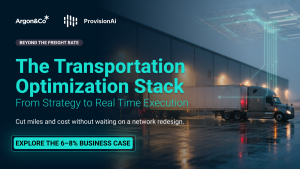

What carriers see in your freight shapes the rate they quote, as much as diesel and capacity do.
When diesel rose 93 cents a gallon in three weeks, the first call many transportation leaders made was to their carriers. It made sense. The EIA's national average went from $5.599 at the end of August to $6.529 on September 21. Fuel surcharges were moving, spot quotes were harder to predict, and rates agreed to in the last bid no longer described the market. Meanwhile, finance still needed a number for next year's freight budget.
There's a conversation worth having alongside that call, and it happens inside your own building. What does our freight look like from the carrier's side of the table?
By Tom Moore, Founder and CEO, ProvisionAi
Last updated: November 2026
What a carrier actually sees
Fuel is only part of it. Truck capacity is running 24 to 30% below last year, and carriers are turning down about one in seven contract tenders. Your carrier still has to find a truck and a driver for your load, on the day you need it.
Most truckload freight in North America moves on smaller carriers, and they plan around commitments: a set number of loads, on a set lane, on a set day. Your annual award tells them how big the opportunity is. Your tenders tell them whether they can build a week around it.
Carriers reject tenders from shippers they value for ordinary reasons. The notice was too short. The volume that day was higher than the trucks they had positioned. Or a better-paying load came along. Rising fuel adds to that pressure, because the carrier pays at the pump before the surcharge catches up.
First-tender acceptance is the clearest signal of how well your freight fits the carrier's capacity. When it drops, loads move down the routing guide to backup carriers or the spot market. Each step costs more and takes more calls to cover.
The pattern gets priced
Years ago, a client told me how hard it was to ship two trucks one day and 20 the next. On the 20-load days, the receiving sites couldn't take the volume, trucks sat in detention, and order fill suffered. That problem is where LevelLoad started, and it's still the pattern I see most often.
A lane awarded as steady volume but tendered in bursts tells a carrier two things: it may have to hold trucks it does not use, and it will receive short notice on the days those trucks are needed. The carrier prices that variability into the next bid or responds through tender rejections in the meantime. Either way, the shipper pays for the inefficiency.
There's a simpler problem underneath. A negotiated rate only applies to the loads your core carriers accept. Every load that ends up on the spot market is paid at the market's price, whatever the contract says.
So a rate conversation built only on market benchmarks can miss part of the picture. The carrier is pricing the lane and the fuel, and also how reliably it can plan around your freight.
"When fuel, capacity and carrier costs change, companies need to revisit more than their negotiated rates. Material sourcing, inventory deployment and shipping schedules all shape the freight carriers are being asked to move. The opportunity is to understand which of those decisions can change to create a more predictable, efficient transportation operation that can adapt as conditions shift."
Rob Achtzehn, Associate Partner at Argon & Co
Two changes carriers notice right away
The first is notice. To reserve a truck, a carrier needs the origin, destination, ship date and equipment type. It doesn't need the final product mix. Where your systems and carrier agreements allow it, you can tender a placeholder order days ahead and decide the contents closer to ship date. In a tight market, the shipper who tenders first usually gets the capacity.
Earlier notice also opens options a last-minute plan rules out. On long-haul replenishment lanes, intermodal has recently been priced at roughly a 34% discount to truck, and it burns far less diesel. It only works if the freight is committed early enough, and the inventory can absorb the extra transit time.
The second change is steadiness. When daily volume on a lane is smoothed to a number the carrier can staff, acceptance becomes easier for both sides. The receiving site has to be able to take it too, so the plan has to work for the warehouse as well as the carrier.
Kimberly-Clark tackled that pattern across North America. With LevelLoad, its planners work from a thirty-day, capacity-constrained deployment schedule and deal with peaks before they turn into a scramble for trucks. Daily variability fell 60% and first-tender acceptance reached 97%, working with the planning, ERP, TMS and warehouse systems already in place. Read the Kimberly-Clark case study.
What it's worth in a fuel market
The EIA expects diesel to ease over the next year. Capacity is another story, and an uneven freight pattern doesn't fix itself. Every load that moves with a core carrier at an agreed rate, instead of on the spot market, is one less exposure to that day's price. Steady, early freight doesn't make diesel cheaper. It puts you back in control of how you buy transportation.
Then negotiate
None of this replaces the rate conversation. It changes what you bring to it. A carrier that sees earlier, steadier tenders can plan drivers and cut empty repositioning miles. How much of that shows up in the rate depends on the lane and the market, but a demonstrated change in your freight is a much stronger position than asking for relief because the market moved.
Before the next carrier call, have three numbers in hand: daily tendered volume on your top lanes against awarded volume, average tender lead time, and how first-tender acceptance has moved since diesel started climbing. If those numbers look uneven, the carrier already knows it.
The contract itself, from surcharge terms to how the next bid is structured, is the other half of the freight bill. It works best when it's written around a freight pattern carriers can count on.
Sources
- U.S. Energy Information Administration, Weekly Retail Gasoline and Diesel Prices
National average diesel prices from August 31 to September 28, 2026. - U.S. Energy Information Administration, Short-Term Energy Outlook
Diesel price forecast for the next year. - CCJ, September 23, 2026
Truck availability 24 to 30% below a year ago (DAT) and tender rejections at 14% (TRAFFIX). - FreightWaves, August 24, 2026
Intermodal priced at about a 34% discount to truck. - Pulse 2.0, Tom Moore interview
The origin of LevelLoad: two trucks one day and 20 the next. - ProvisionAi, Kimberly-Clark Case Study
Daily variability reduction and first-tender acceptance results with LevelLoad.
Related resources
- Carrier first tender acceptance
- Tender rejection rate and routing guide: why carriers reject loads and how shippers reduce it
- LevelLoad: transportation network planning
- Deployment planning
- Diesel 2026 record: what it means for freight
- Truckload freight cost reduction
See what carriers see on your network
Talk with Tom Moore about what carriers see in your tender patterns and lead times, and where steadier, earlier freight could improve acceptance and lower your transportation cost.
About the author. Tom Moore is the Founder and CEO of ProvisionAi.