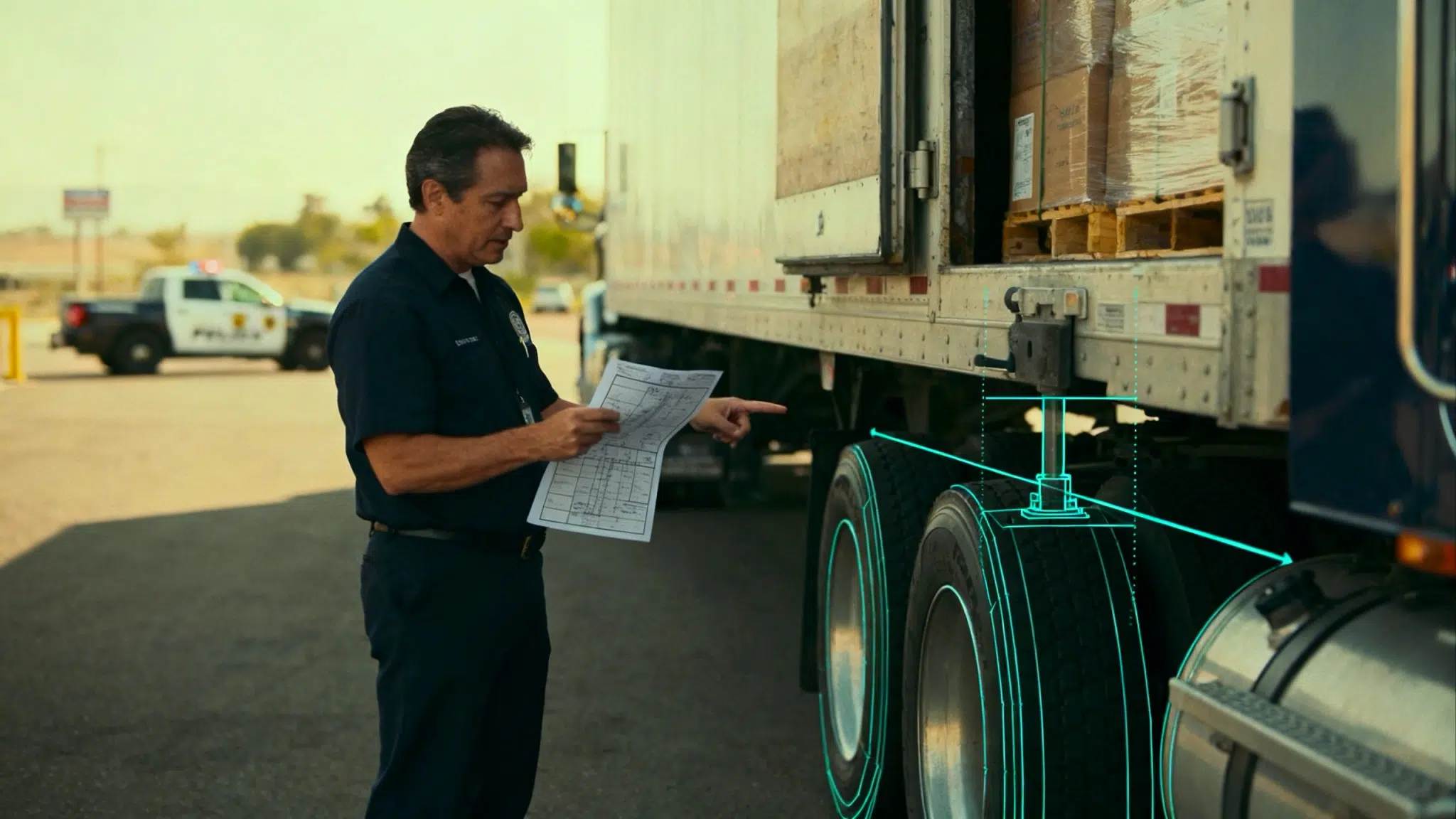

What Is a Truck Loader’s Guide — and Why Your Team Needs One
Ask five people on your team how they load a trailer and you’ll get five different vocabularies. Some call it pallet building. Others call it load building, load planning, or just “loading the truck right.” Different words, same job: getting a legal, stable, damage-free load onto every trailer that leaves the dock.
That’s harder than it sounds. A single load has to satisfy the law (legal axle weights), the customer (a complete, undamaged order they can actually unload), the driver (a load that won’t shift), and the manager (loaded fast, without rework). Optimize for one of those and it’s easy to quietly break another — a load that’s perfectly legal on weight can still arrive at a customer’s dock with pallets crushed, or take twice as long to unload because nobody thought about door width.
Where most loading problems start
Axle weight is the one that gets people in real trouble. It’s not enough to keep the total under 80,000 lbs — weight has to be legal on each individual axle group, and that shifts depending on where pallets sit in the trailer. It behaves like a seesaw: move weight toward the nose or tail and you change what lands on each axle. Above about 40,000 lbs, that’s not something to eyeball — it needs real calculation.
Damage is the other recurring failure. A load can look perfectly stacked leaving the dock and still arrive different at the customer’s end, because stacking order, bracing, and gaps between pallets matter more than how tidy the load looks at departure.
The short version
If your team only has time for a few rules, in order: get the axles legal, keep incompatible products apart, brace forward, brace sideways (especially on the second level), and meet the customer’s expected unloading pattern. Everything else — family grouping, retrieval order, dock-door orientation — matters, but matters less than those first few.
Where to go for the full playbook
We put together a complete, practical breakdown of all of this — axle weight rules, state-specific requirements like California’s bridge law, bracing and stacking do’s and don’ts, intermodal-specific rules, and a full priority checklist for when you can’t do it all — in our Loader’s Guide to Truck Loading.
It’s built for load planners and truck loaders who want the actual rules, not just the theory — including the calculations most teams end up handing off to software like AutoO2 once loads get heavy and the axle math stops being something you can do in your head.